The Clicker Retriever was originally published on the Totally Gundogs website. We are currently moving our library of hunting dog content to Dogsnet, you can check out that link for an update. This article describes the method I used when I first started training the clicker retrieve.
The Clicker Retrieve was originally published in several parts, and they have been combined here. It’s worth bearing in mind that this information was published over a decade ago and both my own training methods, and training methods within the wider hunting dog community have changed. Much of the content is still relevant though. And I hope you enjoy it!
It is some years since I first started clicker training and I have taught the clicker retrieve to quite a few dogs now. But I still remember the first time very clearly and the sense of epiphany it gave me as I realised the power and scope of the clicker trained retrieve to overcome a range of retrieving difficulties.
Retrieving and delivery problems
The clicker retrieve overcomes the following problems:
- The dog that won’t pick up the dummy
- The dog that spits out the dummy
- The dog that runs away with the dummy
- The dog that won’t let go of the dummy
It is not the only way of solving these problems, but I am convinced that in many cases it is the best way.
Over the years I have modified and simplified my method so if you have read my original version you will find this one a little different because I now begin by teaching the dog to pick the dummy up from the floor, rather than by taking the dummy from the trainer’s hand.
I have also become aware that there is one slightly tricky part of this process where people are most likely to get stuck. I have addressed this part in some detail to enable you to progress smoothly through the entire process.
The clicker retrieve
The clicker retrieve is not a ‘quick fix’. You will need to set some time aside for ten minute training sessions, preferably two or three times a day, but certainly at least four times a week.
The whole process will probably take from one to four weeks depending on how often you train, and on what problems your dog had to begin with.
Any dog can be taught to retrieve using this method, even a dog with little or no retrieving instinct.
However, the clicker retrieve is not a substitute for retrieving instinct.
It probably won’t turn a gundog with no interest in retrieving into a really passionate retriever and is best used for teaching a nice smooth delivery once an enthusiastic retrieving habit has been established.
Four parts to a trained retrieve
I have divided the clicker trained retrieve into four parts
They need to be taught in this order, but you can miss out the first part if your dog already picks up a dummy quite happily.
Part 1: Touching The Dummy
You can do this at home in your kitchen or sitting room. Or outdoors in your garden.
You will need a retrieving dummy. The standard 1lb canvas dummy like the one in this picture, is fine.
Touching the dummy
At each training stage you will have an objective. Our objective for this first part is to get the dog to deliberately touch the dummy. It is a small step but an important one.
Here are the steps you will need to work through to get the dog to touch the dummy
- Looking at the dummy
- Approaching the dummy
- Touching the dummy
Now if your dog already picks up any dummy he happens to find even indoors, you will be able to move rapidly to the next stage ‘Picking up the dummy’.
However, bear in mind that many dogs who willingly pick up a ‘thrown’ dummy will not necessarily pick one up just because it happens to be there on your kitchen floor.
Many more dogs will show an interest in a dummy on some occasions and not on others. This is where we change that. At the end of this stage your dog will be repeatedly interacting with the dummy throughout your training session.
Define your sessions
Set out a certain number of treats, fifteen to twenty treats is fine for the first session, and stop the session when you have used them all. Put the dummy away discretely whilst the dog is collecting a treat. You can sit down or stand up, but if your dog is not at all interested in dummies I would sit down. You may be there for a little while.
What is C&T
This is just the abbreviation for Click and Treat. You click when you get the behaviour you are looking for and you treat the dog immediately after the click.
Each time you press the clicker you will throw the treat away from the dummy, so that the dog has to actively and deliberately return to the dummy in order to get another treat.
Here are the steps
- Place the dummy (don’t throw it) on the floor
- As soon as the dog ‘looks’ at the dummy C&T
- Repeat until the dog starts to approach, and take more interest in, the dummy
- Create an imaginary circle around the dummy. Make it three or four feet in diameter
- Now only C&T when the dog moves into the circle
- When the dog is moving into the circle repeatedly (at least three times in a row) shrink the circle
- Repeat until the dog touches the dummy
- Now you will only C&T when the dog touches the dummy
- Repeat until the dog touches the dummy five times in a row
- Now you are ready to move on to the next stage ‘Picking up the dummy’
We will look at that next time
What if the dog loses interest?
Dogs only stop playing this game for two reasons
- They are not hungry
- Your treats are mean
If your dog loses interest get some better treats. Think moist and juicy. Little bits of roast chicken, beef or ham are ideal. Ditch the boring dry old biscuits. And train when your dog is hungry. Don’t worry or fret about your dog’s instincts or lack of them. This is not about instinct. It is about creating a reliable trained response.
Keep sessions shortish (ten to fifteen minutes is quite long enough, shorter is ok). Four five minute sessions is better than one twenty minute session.
Part 2: Picking Up The Dummy
The objective of this stage is to finish up with a dog that lifts the dummy clear of the ground, and then spits it out again.
There needs to be a least a moment during which no part of the dummy is touching the ground for you to be certain that you have completed this stage, and the dog must have let go of the dummy of his own free will.
What if the dog won’t let go of the dummy?
On no account get involved in a wrestling match with your dog over the dummy! Some dogs seem to have trouble letting go of the dummy once they have it in their mouths. Other dogs are actually ‘possessive’ over the dummy and don’t want to share it with you (or anyone else) This stage in training overcomes both these obstacles.
Stages in Part Two
Here are the stages you will pass through in order to reach your objective.
- Nudging or pushing the dummy
- Grasping the dummy with open mouth
- Lifting any part of the dummy off the ground
- Lifting the whole dummy off the ground
Some dogs will go straight to lifting the whole dummy off the ground, and that is fine. But you must ensure that the dog spits out the dummy to go and collect the treat that you have thrown. Throw the treat well away from the dummy to give the dog an opportunity to deliberately return for another go.
If your dog is reluctant to spit out the dummy try again with juicier, tastier, treats when he is properly hungry.
You won’t be tied to the treats for the rest of your days.
This is just a way to establish the trained response we are looking for.
Here are your steps
- Place the dummy on the floor
- C&T for a nose touch
- C&T for a more sustained and determined interaction with the dummy. E.g. when you get a longer nose touch, or a double nose touch or any movement of the dummy
- C&T for any ‘open mouthed’ contact with the dummy
- C&T for deliberate ‘grasping’ of the dummy by the dog’s mouth
- C&T for any action which results in the dummy being lifted off the ground at either end
- C&T for higher lifts of the dummy at either end
- C&T only when the dummy clears the ground completely
At each step you are becoming more selective in your requirements, but at no point should you keep pushing on with this process if the dog is not earning C&Ts regularly.
If the dog stops earning clicks, back up with your criteria for a while before raising the bar again.
Next time we will be teaching the dog to hold on to that dummy for several seconds!
Part 3: Holding The Dummy
Part Three is where we teach the dog that to earn his C&T he needs to pick up the dummy and hold it in his mouth for a while.
We do this by increasing the time he will hold the dummy for very gradually.
The objective of this stage is to end up with a dog that will pick the dummy up off the ground and hold it in his mouth for ten seconds
Moving the goalposts
At the end of part two, you had a dog that would lift a dummy clear off the ground. He would then spit it straight out again in anticipation of his reward.
The next time he does this, you are going to stand and wait. No C&T, nothing. Just wait.
The dog will then pick the dummy up again. Now you can C&T. You are going to continue intermittently rewarding the dog for his pick-ups and watching him very carefully.
You will notice that sometimes he holds on to the dummy longer than other times. These longer holds may only be a couple of seconds, but these are the ones you are going to C&T in future.
Any pick-up where he spits out the dummy immediately must be ignored. You can count in your head as he picks up “one thousand two thousand click” Once you have a repeated two second hold you can begin to build on it.
Here are your steps
- Place the dummy on the floor
- C&T intermittently. You are looking for a two second hold
- Once the dog will hold for two seconds every time, start looking for a three second hold
- Next only C&T a four second hold
- Next only C&T a six second hold
And so on. Take it slowly, set the dog up to win.
How can I encourage my dog to hold longer?
Mostly this is just a question of patience. The dog is learning that in order to get a C&T he needs to figure out what behaviour you are looking for.
He will try different approaches and sooner or later one of those will be longer holds. Some dogs will hold longer if you take a couple of steps back, they will follow you and keep the dummy in their mouths.
Others will let go if you move and are more likely to hold if you stand very still. You may need to experiment.
Avoiding extinction
Remember, if you fail to reward a behaviour for long enough it will become extinct. While you are ‘raising the bar’ don’t let the dog go too long without a reward, you don’t want to extinguish your ‘pick-up’.
Moving on
Once you have a reliable, repeatable, ten second hold we can move on to the next stage.
Part 4: Delivering The Dummy To Your Hand
At the end of this section we will also look a how you can take this trained retrieve out into the field and start using it for real retrieves.
From spitting out to delivering to hand
You are going to teach the dog that instead of spitting out the dummy to get his treat, he needs to place it into your hand.
There are a number of different ways to get this delivery to hand.
Some clicker retrieves teach the delivery first, before teaching the dog to pick up off the floor.
I used to do this. Some teach it at the end as we are doing here, but also teach the dog to touch the handler’s hand with his nose, and then put the pick up and hand touch together.
I don’t do that.
The way I do it is to shape the approach, add a sit, and then teach the dog to hold on to the dummy in front of me, and finally to place it deliberately into my outstretched hand.
None of these ways is right or wrong, they are just different ways of doing things.
Remember that the click marks the end of the retrieve, and the dog must let go of the dummy when he hears it. Later we can replace the click with a ‘release the dummy’ command.
What if he doesn’t let go?
It is really important that you do not attempt to take the dummy from the dog. If you have had problems with your dog wanting to ‘possess’ or ‘run away with’ the dummy then he is more likely to want to hang on to it. The clicker retrieve helps to resolve this by teaching the dog that it is rewarding to release the dummy. He must learn to ‘spit out’ before he learns to ‘deliver’
If the dog does not spit out the dummy when he hears the click, you need to encourage him to do so. Show him the treat, put it near to his nose and wait for him to drop the dummy. If he still hangs on to it, your treats need to be revised. Try moist juicy meat, (roast chicken, beef or ham is ideal). And train when he is hungry.
Before we move on to delivery, let’s get the dog to bring the dummy right in close.
Approaching you with the dummy
Getting the dog to approach you with the dummy is usually very simple. You have the treat which he wants, and he has learned to hold the dummy in his mouth. Stepping back, patting your leg, or gently saying his name is usually enough to get the dog moving towards you.
Remember that each session starts with you placing the dummy on the floor. As soon as the dog picks up and raises his head, take a couple of steps back and encourage him towards you. Move back a bit further if necessary to get him moving too.
You will C&T any movement towards you at all whilst holding the dummy. Do not wait for the dog to reach you. C&T the first two steps in your direction. If you struggle with this, you can first C&T him for turning his head in your direction.
Do not put your hand out or try to take the dummy yet.
Once you have the dog moving at least two steps towards you with the dummy in his mouth, five times in a row, you can raise your standards a bit. Now you will only C&T when the dog reaches you.
So as soon as he picks up, take a couple of steps back as before then stand still as he moves towards you. C&T when he is right in front of you, don’t C&T if he spits out before he reaches you.
Practice moving in different directions and over slightly longer distances.
Do not put your hand out or try to take the dummy yet!
Once the dog will approach you with the dummy in his mouth, consistently, five times in a row, you can start to add the sit.
Adding a sit
Many gundog trainers do not worry about a sitting delivery, however, I have found that with the clicker retrieve adding a sit is helpful because it encourages the dog to lift up his head and makes him less likely to shuffle about. It seems to make the process ‘smoother’.
To add the sit, you will simply ask the dog to sit when he reaches you. If he spits out the dummy before his bottom hits the ground, no C&T. Provided that the dummy is still in his mouth you need to C&T as soon as he completes the sit.
Then you will need to add a few seconds to the ‘holding sit’. So that you reach a point where the dog brings you the dummy, and sits in front of you holding it for several seconds
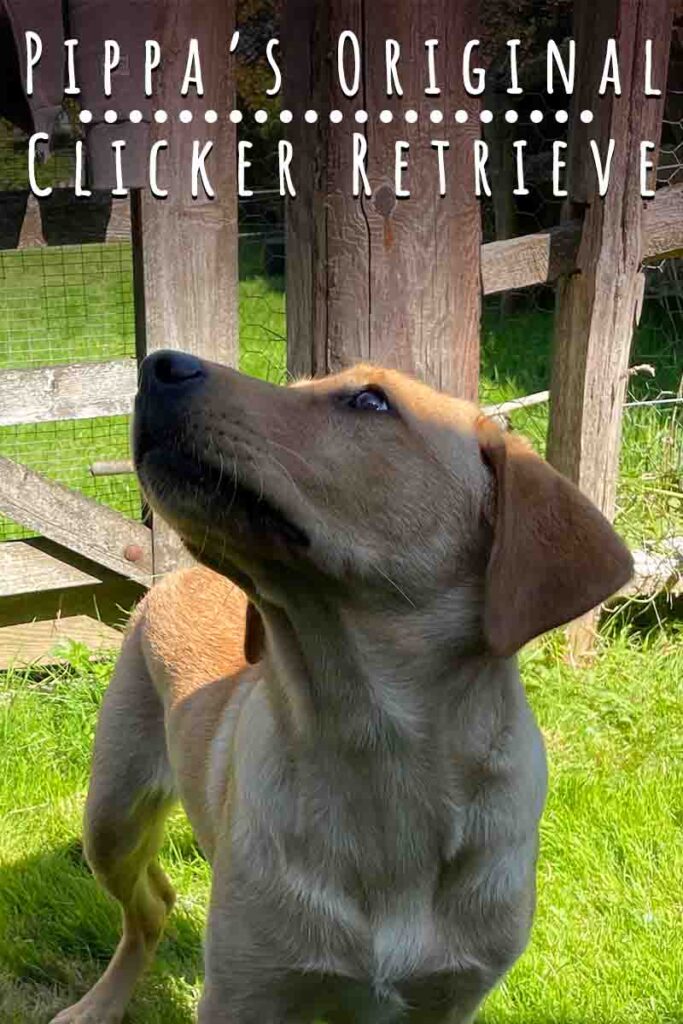
Build up the number of seconds slowly, two seconds, then three and so on, and keep your hands away from the dummy! See the picture at the top of the page.
When you have a nice sit and hold of around five seconds at the end of each pick up, you are ready for the delivery.
Delivering to hand
Because the dog is used to seeing your hand produce a treat, it is a very natural reaction for the dog to spit out the dummy as soon as you move your hands towards him. This is why traditional trainers do not like to use treats for retrieving.
However, it is a straightforward matter to teach the dog to carry on holding the dummy until you are ready for him to release the dummy into your hand. It just needs to be carried out in little steps.
Have your dog sit in front of you holding the dummy, have your hands well up and away from the dogs mouth.
Now decide which hand you are going to use to receive the dummy and move ONE finger of that hand. Just wiggle it a bit.
Is the dog still holding the dummy? Good, then C&T
Did he spit out the dummy when he saw your finger move? This is very common. Do not C&T. Take a couple of steps away from the dummy and wait for him to pick it up again. Wait for him to approach you and sit holding the dummy. Now repeat as above only with a much smaller movement of your finger.
Repeat until you find a movement of your finger that does not cause the dog to spit out the dummy. Get five successful C&Ts in a row before returning to a bigger and more obvious movement of your finger.
Build up slowly adding more movement of the hand until you can move any of your fingers around without the dog letting go of the dummy.
The next step is to teach the dog to hold the dummy whilst you move your hand towards him. Only a small movement to start with. Just move your delivery hand half an inch or so towards the dog and away again.
Do not try and grab the dummy yet. Just move your hand towards the dog a little bit and then away again. C&T if he holds the dummy until you have completed this movement, make the exercise easier if he doesn’t.
Repeat until you have your five in a row then gradually increase the movement of your hand until you can put out your hand and hold it underneath the dog’s mouth without him letting go.
Still do not take the dummy. Bring your hand away and C&T.
The dummy is still dropping onto the floor. Take some time over this step. Make sure that the dog is completely comfortable with your hand coming to towards him, being placed under his mouth, and taken away again.
Into your hand
From there progress to putting your hand below the dog’s mouth and then raising it to touch the dummy. Still the dog must not let go until you C&T. Once he is comfortable with this you are ready to leave your delivery hand in place as you C&T so that the dummy drops into your hand when the dog lets go.
At last the dummy is being released into your hand and not falling on the floor. Whilst the dog is collecting his well earned treat you can put the dummy back on the floor and move away from it for the next repetition.
Practice until you have five perfect deliveries in a row. Now it is time for the finishing touches.
The dog becomes responsible
This important stage makes the dog responsible for ensuring that the dummy is delivered safely into your hand. The way you do this is to begin to make it a little more difficult for the dummy to land there. Put out your hand but instead of placing it directly under the dog’s mouth have it slightly to one side.
The first time you do this the dummy will drop to the floor. Say nothing. Do not C&T. Just wait for the dog to pick it up again. For the next couple of deliveries make sure that the dummy lands in your hand. Now try moving your hand to one side again, letting the dummy fall to the floor.
As you repeat this process, sometimes letting the dummy fall, and sometimes making sure it drops into your hand, the dog will work out that if the dummy falls into your hand he will get his reward, but if it falls to the floor, he will not. When this realisation dawns on him, he will begin to deliberately ensure that the dummy lands in your hand by moving his mouth over your hand in a purposeful way.
This is a bit of a Eureka moment.
Some dogs grasp this more quickly than others, but they all get there in the end. Don’t rush it, or allow the dog to experience too many failures along the way, make sure that the dummy sometimes lands in your hand so that he can be rewarded some of the time.
Maintaining standards
Once the dog is deliberately moving the dummy into your hands, you can develop the final delivery position that you want. I recommend that you keep your hand close to your body and ensure that the dog has to lift his head up high to deliver. Obviously the height of your hands at this point will depend on the height of your dog.
Now you have raised your standards, be sure to keep them high. Don’t accept anything less than a purposeful and tidy delivery right into your hand.
Never reward for a dummy that falls on the floor and never reach your hand out to a dog that is moving his head away from you or ducking it down.
The release command
Now you have your nice delivery you can begin to add the release command. I use ‘dead’. You can use ‘give’ if you prefer. It does not matter. Just say your release command immediately before you click. After a few sessions, the word ‘give’ predicts the click, and you can start to omit the click.
It goes from this:
The dog approaches you with the dummy in his mouth and sits in front of you. You place your hand under his mouth and say ‘dead’ followed immediately by C&T. The dog releases the dummy into your hand.
To this:
The dog approaches you with the dummy in his mouth and sits in front of you. You place your hand under his mouth and say ‘dead’. The dog releases the dummy into your hand and you give him a treat.
What if the dog won’t release when you say ‘dead’? Just wait patiently show him the treat, click if he doesn’t let go within five seconds. Within a few repetitions he will be releasing the dummy on your cue.
Proper retrieves
You can now begin turning your new trained retrieve into the ‘real thing’ outdoors. Start with very short and very obvious retrieves. Literally a couple of yards away. Get the dog picking these up outdoors and in different locations, then start to increase distances gradually.
Once you have successfully tacked your trained retrieve and delivery on to the end of some ‘real’ retrieves, you can begin to make your rewards more intermittent and unpredictable. For many gundogs, retrieving is in itself highly rewarding and motivating. But the delivery still needs to be recognised as a ‘sacrifice’ for many dogs, and one that needs the motivation of a reward. Especially early on in the dog’s career.
Once a dog is involved in fieldwork, and retrieving real game, he is likely to be only to happy to hand you a bird so that he can have the fun of finding another one. But for the time being, remember to reward your dog with a nice treat every now and then, for handing over his precious retrieve.
Problems?
If you find yourself struggling at any point always go back a step to a stage where you were succeeding. Clicker training should be an upbeat and fairly fast process: action-click-treat, action-click-treat, over and over. Check out Youtube for clicker training videos
The pace of clicker training is sometimes a surprise to traditional trainers but the constant action helps to hold the dog’s interest. Never persist if the dog is not winning treats, always go back to a point where he can earn rapid and successive rewards. Then move forwards again gradually. Everybody has to do this at some point in the process.
Let’s sum up
In this section you will need to work through the steps as described above. Take it one step at a time. You will get there.
- The dog walks towards you holding the dummy
- The dog sits in front of you holding the dummy
- The dog holds the dummy whilst you move your hand a little bit
- The dog holds the dummy whilst you put your hand beneath his mouth and then withdraw it
- The dog releases the dummy into your hand
- The dog deliberately places the dummy into your hand
You started this section with a dog that would pick up the dummy and hold it for several seconds. You made sure that the dog would spit out the dummy when he hears the click.
Once you have worked through the steps above you will have a dog that will pick up the dummy from the ground and deliver it into your hand. If he drops a dummy, he will pick it up again.
He will ensure that the dummy is delivered safely into your care at all times.
Keep your standards high, and he won’t let you down.
Free Training Tips
Get Pippa's free dog training tips delivered to your inbox
 Raising And Training A Bichon Poodle Mix