[wp_ad_camp_2]Is your dog obedient until a rabbit runs past? Does he ‘bolt off’ after birds or even butterflies? Chasing behviours are often a problem in young gundogs, particularly in spaniel breeds, and most especially in springers.
Despite a promising initial start, many gundog owners have all but lost control of their dogs by nine months or so. They are unable to prevent their lovely young dog chasing rabbits, butterflies, birds, leaves, even sheep. All their efforts to get the dog to obey the recall commands they thought he understood, fly out of the window.
The owner is often quite desperate and wants to know how to stop this behaviour and to get the dog to come when he is called.
Powerful hunting urges
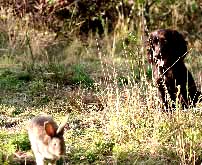 Why do many spaniels and quite a few retrievers cause their owners such problems and what is the answer?
Well, part of the solution is understanding what is causing the problem.
Working bred Springer spaniels (and cockers too) are ‘hard-wired’ to hunt. That is to say they are born with a powerful instinct to search for, flush and chase anything that moves. To the competent gundog trainer this is not a problem; in fact it is just what he is looking for. However, he approaches training his dog from a very different perspective that that of the average pet dog owner.
A different perspective
Effective gundog training is a process of teaching the dog ’what to do’ in any given situation, rather than teaching him ’what not to do’. Strictly speaking, we don’t teach a dog ‘not to chase game’. Rather we teach him what he should do in the presence of game. This might be to complete his retrieve, or to walk to heel if he is a retriever, or to sit to flushing game if he is a spaniel. A working gundog is always on a ‘mission’ whether that mission is a retrieve or to hunt. The dog knows what his mission is, and understands that he must stick to the job in hand and not change the rules in any way.
The Self-Employed dog
The pet gundog is often exposed to a situation in which he has no absolutely no idea what he is supposed to be doing. Commonly this is referred to as a ‘walk’. Once the puppyish phase of a strong dependency on the owner is past, typically at 6-9 months of age, the young gundog with his inbuilt hunting instinct, when taken for a walk, will hunt. After all, the owner hasn’t asked him to do anything else, so hunting seems like the best plan. Sooner or later something will move – a leaf, a bird, a rabbit and the dog, already in ‘prey drive’ and ‘high’ on adrenaline will give chase. Your whistle or desperate pleas for the dog to return have absolutely no chance whatsoever of being obeyed.
Teach your dog to follow you, not the other way around
People experience endless problems with pet gundogs chasing things, simply because they haven’t taught them what else to do, or because they allow them to be exposed to powerful temptations before they have trained the dog how to cope. Like so many problems, prevention is simpler than cure. When you take a young dog out for exercise, try to resist the temptation to walk in a straight line. It makes you very predictable, and the dog may begin to feel confident in venturing further and further afield in the knowledge that you will be plodding along in the same direction when he returns. The more independent the dog, the more you will need to keep changing direction. This forces the dog to keep an eye on you. Your objective should be for the dog to be following you, and not the other way around. Keep away from high risk areas where there are lots of other dogs around or rabbits to chase. You cannot train a dog under these conditions.
In areas where you cannot be certain there are no distractions of this nature, have your young dog wear a training lead so that you can prevent him amusing himself without you if the unexpected occurs
Teach your dog a solid recall command
People sometime say ‘my dog’s recall is great until another dog comes by’ or ‘another person, or a ‘rabbit…’ The fact is, teaching a dog to recall where there are no distractions is only the very first rung on the recall ladder. Proofing the recall is by far the biggest part of recall training. Many times what is seen as a ‘behavioural’ problem, is simply a recall problem. Proper recall training is more than just getting a recall established where there is nothing to distract your dog’s attention.
You need to begin at close quarters and only add distractions such as other dogs, people, and game, in gradual stages. If you are not sure how to do this, there are precise instructions in The Gundog Club’s training guides. Build up distances gradually over many weeks and put a strict limit on how far the dog is allowed to go from you. Always recall the dog before he reaches the limits within which he will obey – distance erodes control and is a strong ‘distraction’ or factor of difficulty to a young dog.
Give your dog a job to do
Make sure your dog knows what he is supposed to be doing, whether that is following you, or fetching dummies, find things to occupy him. If you don’t he will surely find amusement for himself.
One of the simplest ways to occupy and amuse a dog during exercise is with retrieving. Make a point of nurturing your dog’s retrieving instincts so that you can give him longer and longer retrieves to keep him fit. If your dog is a spaniel, teach him to quarter from side to side in front of you and never allow him to run around hunting for himself
Do train your dog as a gundog
Even if you never intend to go anywhere near a gun, gundog style training is designed to harness the natural instincts and desires of the gundog and will give him and you great pleasure
Training a dog takes time – most people introduce far too many distractions to a pup at far too young an age. Follow a well-structured training programme such as the one in The Gundog Club training guides. Get the basics well established before you add complications.
Keep your puppy close and out of mischief. If you are careful he need never learn to have fun without you.
More help and information
If you enjoy my articles, you might like my new book: The Happy Puppy Handbook
I have a one year old cocker. He is fine with sheep, horses and even our hens but goes bananas when he hears the neighbours’ guinea fowl. His recall – usually good – goes out the window and he barks and barks running around out of control for up to half an hour. I am trying to give him a shake when back and have time out in a shed but not sure he realises what he’s being punished for. Any tips? Shall I try a zapping collar?
Hi,
I have an 18 month old cocker bitch who is coming along really nicely, walking to heel, sitting when I stop, comes to the whistle or call every time and I’m really happy with her. However, over the past couple of weeks she has started to go out of our garden on numerous occasions when no one is watching her and comes back 10 minutes or so later absolutely puffed out so obviously hunting/chasing. My husband is a Gamekeeper and although he has Springers, I have always worked labs so this is all new to me. We don’t have an enclosed garden and have woods and fields all around, with plenty of game. I really don’t want to put her out in the kennels as I enjoy having her with me inside the house (I have 3 others in too, 2 labs and a Jack Russell). The other dogs never leave the garden without me so I don’t understand why she has started to. How do I stop this? The dogs are always out with me whilst I do the horses, chickens etc and usually stay close by, I can’t keep my eye on her always as am often doing other chores and this is when she sometimes sneaks off. How do I stop her doing this, she has plenty of exercise so its obviously a hunting thing. Any advice you could give me would be gratefully received. I will use her as a beating dog.
Many thanks in advance.
Sue
Hi Sue, I don’t have any good news for you I’m afraid. This is an excerpt from an article I wrote for the Labrador Site on securing your garden
Hi, Pippa,
Like your book Total Recall!! I learn a lot from this book and tell friends about it who is looking for answers to the problems of their dogs. I have a 4 years old husky. He has strong prey drive and i am working on the erge of chasing sheeps and cats. i’ve been using all the tips i learn here and from the book and do see the results!! They say that huskys can never be off leash but my husky does! Thanks again for all the wonderful writing!! PS. i wonder if you know websties or trainers who has expereinces with huskys?
Hi there, I’m glad you liked Total Recall, I don’t know anyone involved with huskies I’m afraid, but well done for making progress with him 🙂
Thank you Pippa, great post!
Teaching our dog to retrieve balls and other toys has been a great help in occupying him and keeping him focused on us rather than chasing birds. Sheep and squirrels have been a bit more tricky so he is on training lead whilst working around those.
We were thinking of introducing him to ‘flirt poles’ with a bit of sheep skin tied to the end, do you have any experience in using these? Most trainers I’ve spoken to have said it is okay to use real sheep skin. Any thoughts are much appreciated.
I don’t have much experience with flirt poles but they are interesting and I am experimenting with one at the moment. You can talk to experienced users on the Positive Gundogs Facebook group
I meant ‘if it is another *dog* he will have his heckles up and growl…
Love you articles Pippa they make so much sense. This one I’m sure was made for my labrador. He is a pet gun dog and we have made all the mistakes you mentioned and now he’s has all the bad behaviours this article includes. He’s driving us to complete meltdown with his hunting/chasing instincts. We really want him to work well and know he would be a great gun dog and comes from great working stock, his mother is a fantastic worker. However as a young dog he had way too much freedom, he has pleased himself for so long and now on most walks catches live game in a very UN controlled way and most of the time he brings it back fine but is now becoming hard mouthed because the game is alive and wriggling, he’s clamping down and shaking it. He’s been under “intensive” training with my partner for a few weeks now but we seem to go a few steps forward and then ten back. Its getting so frustrating that I admit I am close to giving up. We work on his re-call every walk, we use treats, the dummy, we try and keep him within 10 or 20 yards and keep calling him back but if he gets on a scent or spots anything that moves, from game, to people, to another dog, he is gone. Nothing you can do to distract, catch or stop him and if you tell him off it makes no difference because 5 minutes later he will do it again.
I have a training lead but I find it very uncomfortable to use, its a 30ft one and it all just gets tangled and its not easy to hold, plus we have taught him to walk so well on the lead that he won’t go off properly on a training lead because I think he feels he’s being naughty by not staying at my side with a lead around his neck and I don’t want to encourage the bad habit of him thinking he can go off with a lead around his neck.
My partner thinks he is a clever dog and part of the issue is that the dog is taking control, when we recall him he totally comes in his own time, he sniffs about along his way, he will almost every time take a pee up something un-necessarily on his way back to you almost to prolong coming back. He never runs back with enthusiasm, he just wants to be in control and please himself, so by the time he does come back we are already annoyed with him. Its very very hard around us to find somewhere completely neutral to train, there is nowhere. We live on masses of farm land and game keeper land, they rear game here for shoots, shoots go on for miles all around. The hedges, long grass and woods are literally bursting with game, rabbits, farm animals etc, if he’s not catching it live he’s picking up dead things and usually attempts to eat them… another thing we are trying to crack. So as a puppy we haven’t been able to keep him away from anything, even our garden has wild rabbits under the shed, rats, pheasants and even ducks!
So despite always being strict, using gun dog training techniques and always giving our dogs a great life and trying to be the most interesting thing in their lives, to him we aren’t, we are bottom of the ‘interesting’ list. He does everything to please himself, he now even chases sheep, in his over excitement he also can be quite nervous/aggressive where hes so pumped up whatever he catches up with he will just terrorise. If its another day he will have all his heckles up, growl, give chase, usually bowl them over and boss them around, which is embarrassing and dangerous and many owners don’t like him, also now with sheep he gives chase, not only chases but jumps on their backs or knocks them down, its exhausting and exasperating. I have had to stop going out with him all together as I’m 6 months pregnant and can’t cope with him, I end up in tears on most walks out of pure frustration and I’m not usually a softie at all! We call him the untrainable labrador!!! I feel there is no hope as he will always manage to please himself and we don’t feel always sticking him on a lead will teach him anything : (
He was my dream labrador puppy last May, we brought him home at 9 weeks old, I had always had family labs and thought he was what I had always wanted, my very own labrador companion. He was a fabulous puppy, then he hit 5 1/2 months old and all this started and has only gotten worse.
I have your books and am reading all the time to see what we can do to improve and I only hope and pray he will come better in the next 12 months when he is coming up to two.
My working labrador pet is the exact same! I can relate to everything you put. I too had an amazing puppy off lead, come everytime, recalled away from everything. Until 6 months! Then he turned into what I call devil dog.yes obviously see the mistakes he had too much freedom which is now hard to correct. He can’t go off any where and even plays keep away in small fenced areas and tried the long lead but again easier said than done.
Glad I’m not the only one :))
I like the helpful information you provide in
your articles. I’ll bookmark your weblog and check again here regularly.
I am quite sure I’ll learn lots of new stuff right here!
Best of luck for the next!
HI Pippa,
I have a nearly 6month old cocker (Tonks) who Im trying to train to be a gundog. She has so far proved to be great at sitting, staying and the recall, with a whistle for the recall and sit. Unfortunately for the last 3-4 weeks I havent had much time due to work so had been giving her a quick run round the farm during which she has met pheasants and rabbits and deer! she is never far away and does come back but only after 20 seconds or so of chasing til they fly. If a birdscarer goes off she also runs and only comes after 20 secs or so.
I have now more time and have gone back to walks only on the lead, with lots more sitting commands, and the recall in the garden. Every bird in the garden she wants to chase! Has she been ruined? I am starting a bit of retreiving work and she is getting the hang of that, bringing it back quite well (though I have to run away to start). Advice much appreciated!
Thanks
Hi Emily, I wouldn’t want to dismiss any five month old dog as ruined! Try not to worry and focus on moving forward. You will have to work hard at keeping her focused on you as she is now very birdy. Stopping all free hunting now and moving forward with a structured training plan, will be your best bet. Pippa
Hi, I have a 2yr old Toller, who we got as a rescue when he was 14 months. On a walk, his recall is brilliant and he loves the ball. He isn,t distracted by other dogs, I also have 2 other dogs. But recently he has been chasing birds and is so focused on them, I am wasting my time calling him. Even if i throw the ball he just chases the bird with the ball in his mouth.It has got to the stage where I end up putting him on the lead, whenever I see birds.
Hi There I have a 2 year old German Wired Haired pointer cross and I’m desperate for some help in training him. He is a very clever dog too clever! he is great on a lead indoors or where there is no distractions but outside or off a lead he is impossible and getting worse no matter what I seem to do He is always hunting killing, birds, ducks,rabbits etc and wont come back when called he runs for miles and just returns when he pleases, I really want to be able to take him for a walk and know he will stay with me and be at my side without a lead and I would love for him to be off in my yard and stay at the door but he just wanders away and scavenges or chases things, HELP please I feel so cruel having him in his kennel most of the time.
Hi Chantelle, As you are probably aware, you are not in a good position. A dog with strong hunting instincts, that has been allowed to chase and even kill other animals, is a very tough challenge. A thorough training programme, starting from the basics, is the answer. But proofing your dogs behaviour in the presence of animals will take a lot of effort, a lot of time, and you will probably need help from a professional gundog trainer.
In the meantime, it is helpful if you can find a secure area to exercise your dog (e.g.fenced paddock)because each time he chases, the behaviour will be harder to break. As for letting him off in your yard, I presume your yard is not dog proof? And unfortunately no dog can be expected to remain within an imaginary boundary, so your only option there is to secure your yard. Best wishes, Pippa
I am working my way through Perfect Recall with our dog,a 2 year old rescue lab cross. He is now pretty good at recalling from food, other dogs and people on a long lead and it is rare that I need to activate it. I do have to work quite hard to keep him within a reasonable distance as his instinct is to be further away if I allow it. However his overwhelming instinct is to run once he has a scent, and I am struggling to work out how to break this down as a task. We have been working on recalling from a scent when I am a very short distance away, and he is slowly improving but it takes a lot of waving my arms and shouting excitedly to tear him away and I’m not sure if it’s the right way to approach this or whether I should be redirecting him to use his nose another way. Having been reasonably reliable through his training thus far he took off yesterday and it took three hours to track him down. Help! Also, can anyone suggest amazingly motivating treats that are fish based? Turns out he has an allergy and the vet says to eliminate meat protein but since cocktail sausages are our training food of choice I am at a bit of a loss for what to offer as a super duper treat.
Hi Angharad, sorry to hear you have had a set-back. It is really important to try and avoid any further absconding incidents, quite aside from the risk, as you are probably aware, these only serve to convince the dog that he can have fun without you.
The problem with fish based treats is that the good ones tend to be really smelly 🙂 Some people swear by sardines. Might be worth joining the forum and chatting to others there, both with regard to the training and the treats.
Have you taught your dog to retrieve? It sounds as though he would enjoy following a trail that you had laid for him, working trials / tracking might be activities to consider.
Pippa
By the way, I am thoroughly enjoying reading everything you have published on here and on The Labrador Site. I am still exploring it all but everything makes such sense, I only wish I’d discovered it sooner!
I am going to order Total Recall (using the link on this website) and can’t wait to receive it. I will be speed reading to try and ensure I don’t make any more mistakes! My little rescue dog definitely lulled me into a false sense of security during my first couple of weeks with him – now that he is finding his confidence he is becoming much more independent. He comes to work with me so it’s important that I can keep him under control. I look forward to hearing your recommendations on residential training.
Thanks,
Gemma
Hello,
I have a 5 month old Labrador who is obsessed with birds – he chases them even when they are flying overhead! I now keep him on the lead at all times as his recall is non-existent in the outdoor environment. Even on the lead, he is constantly scanning the sky for birds and, when he spots one, strains at the end of his lead and barks, so I know he would chase them if he was off lead. I am coping with all aspects of his training apart from this. The bird obsession is the only issue. His recall used to be brilliant and I know that getting the recall command back is at the root of the problem but I don’t know how to build back up to this. His recall is 100% indoors. But as soon as we go outside he is on bird watch. I am now considering sending him to residential gundog training because I am hoping they will have the facilities (bird pens) and experience to train him out of this; as I am worried that my lack of skill is allowing the habit to consolidate. What are your views on residential training – can it work?
Thanks in advance.
Hi Gemma, yes, residential training can work, and it can be very difficult getting a dog steady to game without access to game under controlled conditions. Another option to residential training is to have regular one-to-one sessions with a professional trainer that will include the use of his facilities. That way you are learning alongside your dog. Pippa
Thanks for your prompt response Pippa. I am going to Snowdonia for two weeks and would usually be able to take my dog, but at the moment he is too young for long days of walking in the hills. So I would have to board him – and I thought residential training would be a better option than normal kennels. Kill two birds with one stone, if you excuse the pun!
Is it realistic to think that they can train him to be steady to game in two weeks? I know this is a bit of a ‘how long is a piece of string’ question. I am just trying to manage my expectations.
Finally, which residential training schools in the Hampshire area would you recommend?
Many thanks.
Hi Gemma, I don’t usually give out recommendations for specific trainers. However, some of the Gundog Club’s instructors offer a residential training service. Any training that the dog receives in your absence will need to be rehearsed by you when you return, and maintained with regular practice. Steadiness is not really like throwing a switch, it is more of a journey, and variations in timescales are simply huge depending on the dog. Hope that helps
Pippa
Thanks Pippa. I have found somewhere and they have also emphasised that I will not be collecting a ‘perfect’ dog, nor will he be miraculously cured of his chase behaviour. I realise that much will depend on how I build upon the foundation that they instil. I am committed to the journey and, with the trainer’s support and using the great advice on these websites and in your book, I should get there eventually. Thanks again,
Gemma
Hi
Interesting comment in your article about the dog being self employed ( ie walked) We have a 15 month lab as our first dog. She does gundog training and seems to love it. When out on walks we mainly keep her close at heel off lead but also give her the odd 5 mins to sniff on her own and some retrieves and hunting in between.
Our friends just walk their dog and let it free. They think we’re too strict but being first time owners were not sure what’s best. What would be your ideal way to exercise your dogs for 30 mins a few times per day? How do you spend each 5 mins of the 30?
Schöner post:)
Thank you 🙂
Wonderful site. Lots of helpful information here. I’m sending it to a few pals ans additionally sharing in delicious. And of course, thanks to your effort!
Thanks Andreas 🙂
We adopted a mix breed (think it’s Bull Dog/Pointer mix) about 2 months ago. She is about 6 mo old. She is a great dog but we’re having a really hard time getting her to come when called and she is obsessed with chasing our pet rabbit. The rabbit free roams the back yard. We put her on a leash and would not allow her to chase for several weeks and she has now been off the leash for several weeks. But she is back to chasing. If I am with her and see her watching before she runs I tell her no and she points without moving until the rabbit hops off to one of his holes, however, if I don’t catch her before she runs…nothing short of chasing her down and dragging her away works. We are afraid she will injur or kill the rabbit. She loves to track him and is very good at it. I suggested to my husband that we train her to bird hunt so she can exercise the part of her that likes to hunt and track. Is this a good idea? Will this just encourage her to continue after our pet rabbit? Is there any way for them to co-exist? We have other dogs and have never had a problem with this.
hi I have a year old cocker try to train him as a gundog, I am have trouble stopping him chasing game and staying close can u help
Hi Terry,
Curing an existing chasing habit takes persistence. It is really important that you don’t give your cocker any more opportunities to practice the habit, and that you get some good ‘brakes’ installed before attempting to bring game back into the equation. Keep him away from game and/or use a training lead to prevent chasing. It is important to introduce your cocker to working amongst game under controlled conditions, eg in a rabbit pen. Some lessons with a professional trainer will give you access to this facility.
Pippa
I have rescued a working springer 4 months agoo=, she is now 18 monyhs old. She is a great house dog, a ‘star’ at obedience class, very socialable with people and other dogs. On a long training lead (20m) she sits, downs, etc close by and at a distance, re-calls immediately, and quite honestly is brilliant. However as soon as she is released from her lead she is off, 2 miles+is not unusual, a distance covered in a couple of minutes! How do I progress from the training lead to off the lead? Suggestions welcome, especially if you have a secure field in Essex or Suffolk.
David
Hi David, well done for taking on a rescue springer, she sounds like a great little dog. Developing a reliable recall in a hunting spaniel is a combination of building up an ingrained automatic response to the whistle at the same time as taking steps to actively manage the dog’s time outdoors. With a spaniel this can mean keeping the dog very close indeed. Retraining a recall can be time consuming in a rescue dog and is examined in detail in Total Recall and there is a great deal of information on recall in the Recall Centre on the Labrador Site.
You might find this series and help my spaniel is out of control interesting too.
Hi Pippa
Thanks for your reply – very helpful!
We have been concentrating on the recall over the past week and that does seem to be improving. We are reading about the trained retrieve and will start on that next maybe…..though we are still not sure about the other things I mentioned in my last post!
Thanks again.
Susie
Hi Pippa
Thanks for your reply above. We have in fact bought the Gundog Training Guide Part 1 ‘Beginner retriever’ since I last posted here. It looks fantastic and really clear and so on. I am afraid Iave a few questions – well quite a few actually! Feel free not to answer all of them, but I thought I’d write them down anyway!!
We have been doing the ‘about turn’ walk for about a week now as we found your post on that before either posting on your site or buying the book . This is going well to the point that it is actually now difficult to get any distance from the dog (Vespa) unless she starts to chase a bird or another dog. We are working in an area with as few distractions as possible, but occoasionally other dogs do appear and when that has happened she has run over to them but has eventually come back and we have been careful not to call her until she is already on her way back. So, that is good but……
In the book it seems that the first thing worked on should be the retrieve. Vespa clearly has a high prey drive and chases anything and everything with great excitement and enrgy. When she catches whatever it is, however, she settles down to destry it rather than bringing it back to us. On the rare occasions when she does come back with stuff she will not give it up and if we even try to put our hands on it she will pull away. We have recently found your post on dogs that play ‘keep away’ and we will read that and try to put into practice your advice there, but we are not clear about whether we should be making sure the recall is reliable before we work on retrieving and then if we are working on it how we are meant to ‘gently remove’ items from her mouth.
We have only recently found all your various sites and we know that prior to this we have made mistakes in her early training. She has had soft toys to chew on and we have used treats to get her to drop things. We now know that this is wrong and we want to correct the problems our actions have caused. We live in a city and there is so much rubbish on the street that we have been anxious about her getting hold of that we need a reliable, NOT treat-based method of getting dangerous things out of her mouth. Her shying away when holding stuff is, we are certain, a result of our trying to remove dangerous things from her and we need help to fix this.
Again, because of where we live, we have to take her out into areas with lots of distractions, on the lead, in order for her to relieve herself. We had been working on her walking to hell and sitting a road crossings and so on because of this, but in your book it seems to imply that one shouldn’t work on these uuntil after you have the work on the retrieve. What should we be doing and in what order? Should we be ignoring on-lead misdemeanours and not trying to make her sit until the retrieve is learnt or can we work on more than one things at a time?
Should she have no toys at all or should she have some and if so what? We have various soft toys (squeaky), a rope (we have never played tug of war with this thankfully) and various hard teething toys.
We are using a rope slip collar – is this right? This is fine when walking and she is concentrating but we do get anxious when she lunges at other dogs and the slip gets very tight on her neck. What can we do about this?
We have bought a 211.5 whistle but not yet started to use this. Will it be clear in your book how and when to use it?
She is a six month old working black lab – we chose working lines mainly for health. Her pedigree is very good (Drakeshead and Broadwath with dozens of FTC in her family tree) and we are very keen to allow her to be the best dog her breeding should allow and it would be a real shame to train her into bad habits as she is such a good dog.
Any advice you can give will be very gratefully received. We have been so excited to find your sites and all the amazing advice you have posted there. We know we have done stuff wrong through following well-meaning but unhelpful general dog training advice and now we have found your information we really want to go for it and get it right!!
Best wishes
Susie
ps we are thinking about whether or not to get her spayed. What are your thoughts on this? Will it make a difference to her behaviour/ability to work and so on….?
Hi Susie,
You cover a range of topics in your comment so I will start with this one.
As you can see, retrieving is a big and sometimes confusing topic! At the moment the website is rather a jumble of articles. I am in the process of creating a retrieving resource page to help make sense of all the information.
In the meantime….
The use of treats in retrieving conflicts with traditional training methods and if combined with those traditional methods results in a puppy that spits out the retrieve.
But the clicker retrieve (which uses treats in a structured way) is an excellent way of dealing with certain delivery problems including dogs that want to keep the retrieve themselves, and including dogs that spit out the retrieve despite having been taught using appropriate traditional methods.
It doesn’t matter that you have inadvertently taught your dog to play keep away, or to drop the retrieve, what matters is that she wants to retrieve. The desire is there. The delivery can be taught. Using treats and a clicker. So don’t worry about past mistakes
You cannot ‘gently take’ an item from your dog’s mouth until she is ready to let go. Which is why there comes a point in the ‘walking away’ process when you have to make a decision as to whether to keep trying to ‘bore’ the dog into letting go. Or to quit, and commit to teaching the clicker retrieve.
But teaching a trained retrieve takes time and patience. And you will struggle to find a gundog trainer that will help or support you. So you will probably have to go it alone. You need to be confident that you can complete the process before you begin.
I suggest that when you have read the ‘keep away’ article, have a look at this one the clicker retrieve and come back with any questions you may have. I think that there is another (slightly different version) of the clicker retrieve in the back of your grade one guide.
I will answer your other questions so please bear with me 🙂
Hi there
I have a six month old working black lab that I am having a few problems with….
Basically, in the house she is well behaved. She can do sit, wait, off, stay, and so on and walks well (up to a point) on her lead on the streets near my flat. However in the local park (just across the road) she is a bit of a nightmare. When walking to heel she is ok until another dog comes along, or a jogger or se rubbish catches her eye at which point she lunges towards whatever has caught her eye and it is really difficult to get her to sit still and wait until we want to move off again. Off the lead she is completely impossible. Many dog owners seem to just let their dogs do what they want and I am not happy to do this. I want her to have a strong recall but I have no idea WHERE to train her to have this. I can do some stuff in the flat but the park is so full of the distractions it’s a complete nightmare. I was thinking of getting your passing grade one book from the gundog club site. Will this give me the instruction I need to sort my puppy put or is there a better book for my needs? Should I be getting a whistle and if so which one – 210.5 or 211.5? Should I get a long training lead – I use a six foot lead at the moment? Etc etc. all advice gratefully received.
Thanks
Hi Susie
It is really important to try and practice calling a dog away from distractions under very controlled conditions.
The same applies to heelwork.
My new book Total Recall is probably the most appropriate to show you how to do this, but it doesn’t come out until July. In the meantime I have put a lot of information about recall and the proofing process (introducing distractions into training ) generally on The Labrador Site.
You will find them in the Recall Training Centre
I hope you find them helpful, please feel free to ask any questions you have when you have had a look through the information in there.
There is information on whistles here Whistles It doesn’t matter which pitch you buy.
Best wishes, Pippa
,